
Pharmacy benefit management (PBM) has always involved complex decisions about drug coverage, pricing, pharmacy networks, and medication access. Much of the work behind these decisions, however, still depends on reviewing claims, interpreting benefit rules, reconciling information across systems, and resolving exceptions.
AI is beginning to change how that work gets done. AI can help identify unusual claims, extract information from clinical documents, detect pricing discrepancies, and prioritize cases requiring human review. For pharmacy benefit teams, this creates an opportunity to spend less time navigating administrative processes and more time addressing the decisions that affect costs, compliance, and patient access.
The shift is already visible across healthcare. Half of surveyed US healthcare leaders reported that their organizations had implemented generative AI, while more than 80% had deployed their first use cases to end users. As automation becomes more deeply integrated into PBM operations, professionals will need stronger capabilities in clinical judgment, data interpretation, regulatory oversight, and cross-functional decision-making.
How AI Is Changing Traditional PBM Roles
PBMs operate at the intersection of healthcare delivery, insurance administration, and pharmaceutical economics. Their responsibilities include claims adjudication, formulary management, rebate negotiations, pharmacy network administration, and utilization management.
These functions generate large volumes of structured transactions and unstructured information, making several activities suitable for AI-assisted processing.
Consider a typical prior authorization workflow. A pharmacy benefit specialist may need to verify coverage requirements, review clinical documentation, identify missing information, and coordinate with prescribers before a decision can be completed. AI can assist by extracting relevant details, checking submissions for completeness, and identifying cases that require additional clinical review. The specialist’s responsibilities can then shift toward resolving complex exceptions, verifying the accuracy of extracted information, and ensuring that decisions follow established clinical and benefit policies.
Similar changes are emerging across other PBM functions.
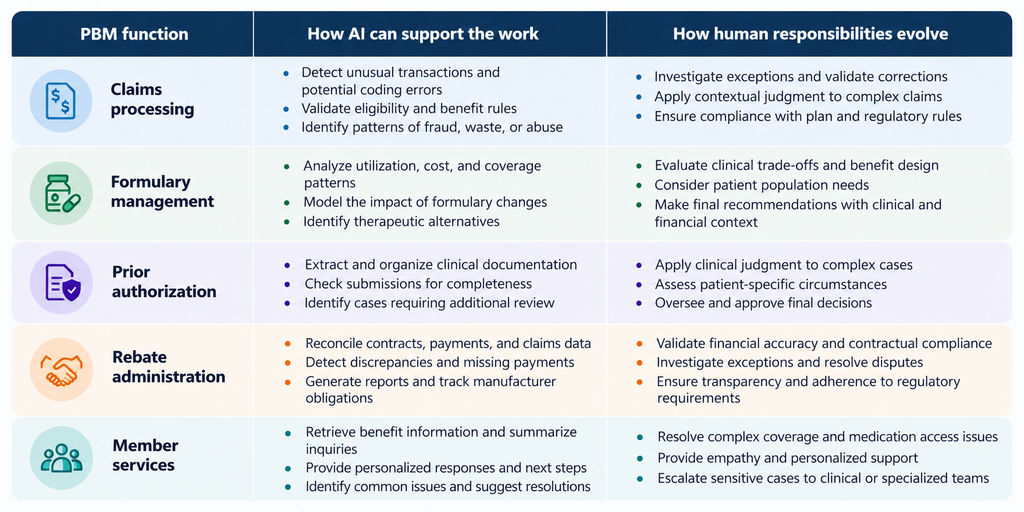
Yet PBM workflows have a characteristic that makes full automation particularly challenging: administrative decisions can carry clinical and financial consequences.
A claim flagged as suspicious may represent a billing error, but it could also reflect an unusual yet legitimate treatment. A formulary recommendation that reduces spending may create access difficulties for a particular patient population. A prior authorization system may correctly identify missing documentation without understanding the clinical urgency of the request.
These situations require professionals who can interpret AI-generated information within the broader context of pharmacy benefit administration. The composition of work within those roles will change, with routine processing increasingly supported by automation and greater emphasis placed on exception handling, judgment, and accountability.
Skills Pharmacy Benefit Teams Will Need in the Age of AI
The growing use of AI does not mean every PBM professional needs to become a data scientist. Instead, the skills required will depend on how closely an employee works with clinical decisions, financial processes, operational systems, or regulatory requirements.
Five capabilities are likely to become particularly important.
1. Data literacy and analytical interpretation
PBM professionals already work with claims histories, prescription utilization, formulary information, and pricing data. AI makes it possible to analyze these datasets faster, but interpreting the findings remains a distinct responsibility. For example, an AI system may identify a sudden increase in spending on a particular specialty medication. Understanding that increase requires examining several possibilities: higher utilization, changes in drug pricing, a shift in patient demographics, or changes in the formulary.
A pharmacy benefit analyst must be able to distinguish between these factors before recommending an intervention. This creates a growing need for professionals who understand data quality, statistical patterns, and the limitations of predictive models. Familiarity with analytics dashboards, SQL, and business intelligence tools can be valuable, particularly for roles involving financial analysis and utilization management.
The challenge is especially relevant because PBM data is often distributed across claims platforms, clinical systems, pharmacy networks, and external partners.
2. Clinical judgment and exception management
AI can process clinical documentation and identify patterns in medication use, but pharmacy benefit decisions often require understanding individual patient circumstances. Consider a patient requesting coverage for a medication outside the preferred formulary. An AI-assisted system might identify an available therapeutic alternative based on established coverage criteria.
However, the patient may have previously experienced adverse reactions, failed other treatments, or have clinical circumstances that make the preferred medication unsuitable. Pharmacists and clinical reviewers must be able to evaluate this additional context and determine whether an exception is appropriate.
As routine administrative activities become automated, the ability to handle ambiguous cases may become a more significant differentiator for clinical PBM professionals.
This also introduces the risk of automation bias: accepting a system-generated recommendation without adequately questioning its assumptions.
A recent McKinsey analysis of clinical AI and the future of healthcare highlights the related concern of deskilling, where excessive reliance on AI can weaken professionals’ ability to perform cognitive tasks independently. PBM organizations will therefore need to preserve opportunities for independent clinical review, case-based learning, and periodic assessment of decision-making skills.
3. AI literacy and workflow oversight
AI literacy in PBM operations involves understanding what an AI system can reliably do, recognizing when its output needs verification, and knowing when a case must be escalated.
For instance, a claims operations specialist using an AI-assisted review platform should understand:
- Which data sources the system uses to evaluate claims.
- How confidence scores or exception flags should be interpreted.
- Which decisions require human authorization.
- How to identify and report inaccurate recommendations.
- How to document overrides for future review.
These skills become more important as organizations introduce AI agents capable of completing multiple steps within a workflow.A system that retrieves documents, checks coverage rules, and prepares a case summary may reduce administrative effort. However, if it retrieves an outdated benefit policy, the error could affect every subsequent step.
Human oversight must therefore extend beyond checking the final output to understanding the workflow itself. The gap between AI deployment and workforce readiness is already becoming apparent. While 80% of surveyed health insurer AI leaders believe nontechnical employees understood responsible and ethical AI use, only 42% of employees expressed confidence in that area. For PBMs, closing this gap requires role-specific training rather than generic AI awareness sessions.
4. Regulatory knowledge and AI governance
PBMs face increasing scrutiny over prescription drug pricing, compensation arrangements, formulary decisions, and transparency. The regulatory environment is also changing how PBM professionals will need to manage information.
The Deloitte analysis of the Consolidated Appropriations Act, 2026 outlines new PBM requirements involving compensation structures and disclosures of prescription drug spending, rebates, spread pricing, and formulary placement rationale. Separately, the US Department of Labor’s January 2026 proposed PBM fee disclosure rule seeks greater transparency into compensation received by PBMs serving self-insured group health plans.
These developments have direct implications for employees responsible for financial reporting, contract management, compliance, and operational oversight. AI may help reconcile financial records and prepare reports, but professionals must still verify that the underlying calculations are accurate and that disclosures meet applicable requirements.
They will also need to understand AI-specific risks, including inappropriate data access, model bias, incomplete audit trails, and unsupported recommendations. For pharmacy benefit teams, governance knowledge will become increasingly relevant to everyday operational decisions, rather than remaining exclusively within legal or compliance departments.
5. Cross-functional communication and problem-solving
PBM decisions rarely involve a single department. A change to formulary policy may affect clinical reviewers, pharmacy networks, financial analysts, member service teams, and plan sponsors.
AI can help these teams access information more efficiently, but it cannot eliminate the need to reconcile competing priorities. Consider a proposed formulary change that appears financially attractive. A clinical team may identify concerns about therapeutic alternatives, while member services may anticipate increased coverage inquiries.
The ability to bring these perspectives together and explain the implications to stakeholders remains essential. Communication skills will also matter when employees need to explain AI-assisted recommendations to colleagues, clients, providers, or members.
A technically accurate recommendation has limited value if the people responsible for implementing it cannot understand its rationale or consequences.
How PBM Organizations Can Prepare Their Teams for AI
PBM leaders need a practical approach that connects skills development to specific operational responsibilities.
Start with a task-level assessment. Identify which activities involve repetitive data handling, which require clinical or financial interpretation, and which carry significant compliance risks. This helps distinguish appropriate automation opportunities from decisions that require continued human involvement.
Build training around real PBM scenarios. A claims specialist should practice investigating incorrectly flagged transactions. A formulary analyst should learn to challenge an AI-generated utilization forecast. A compliance professional should understand how to trace an automated recommendation back to its underlying evidence.
Include frontline employees in workflow design. Employees often know where existing processes create delays, duplicate work, or inconsistent decisions. Their participation can help organizations identify where AI would genuinely improve operations.
Create feedback and escalation mechanisms. Employees need clear procedures for correcting AI-generated errors, reporting recurring problems, and identifying when a model should be reviewed or temporarily withdrawn from a workflow.
Measure operational outcomes alongside adoption. Training completion and system usage are useful indicators, but they do not establish business value. PBMs should also monitor claim accuracy, turnaround times, rework, compliance exceptions, and member experience.
The Future of PBM Work Depends on Human Expertise
AI will continue to change how pharmacy benefit organizations process claims, manage utilization, analyze spending, and administer benefits. Routine activities are becoming easier to automate, while the importance of oversight, interpretation, and complex decision-making is increasing.
For PBM professionals, long-term career relevance will depend on combining established pharmacy benefit knowledge with data literacy, AI proficiency, regulatory awareness, and stronger analytical judgment.
For organizations, the priority is to prepare employees for these changing responsibilities while redesigning workflows around accuracy, accountability, and operational performance. The greatest opportunity lies in creating pharmacy benefit teams that can use automation effectively without compromising the clinical and financial judgment on which reliable benefit administration depends.
At Pointwest, we help healthcare organizations strengthen their technology capabilities through data and AI, quality engineering, and digital transformation services. As PBM operations become increasingly AI-enabled, dependable data foundations, rigorous system validation, and well-designed workflows will be essential to supporting the teams responsible for managing them.
The future of PBM work will ultimately depend on how effectively organizations develop their people alongside their technology.