Enterprise data volumes are expanding across financial transactions, digital commerce platforms, electronic health records, applications, customer touchpoints, IoT systems, and partner ecosystems. Yet scale alone does not create advantage. The ability to consolidate, govern, and activate data determines whether organizations move faster than competitors or remain constrained by legacy systems. A modern cloud data platforms is now central to that equation, not simply as storage infrastructure, but as the analytical backbone of the enterprise.
This blog examines how modern, cloud-first data platforms support enterprise-scale analytics, outlines architecture strategies that prevent fragmentation and performance bottlenecks, explores governance and operating model conditions, and analyzes emerging design trends shaping cloud-native data environments. The objective is to move beyond tool selection and focus on how to architect a cloud data solution that delivers measurable business impact.
Why a Unified Data Platform is Central to Enterprise Data Strategy
Enterprises increasingly view cloud as the “default platform” for data workloads. According to Deloitte’s 2025 analysis on hybrid cloud strategy, leaders are grappling with rising cloud costs, data sovereignty concerns, and modernization needs, but the strategic value of cloud remains clear: it enables scalability, agility, and performance that legacy systems cannot match. Optimizing cloud infrastructure becomes a prerequisite for analytics and insight delivery at enterprise scale.
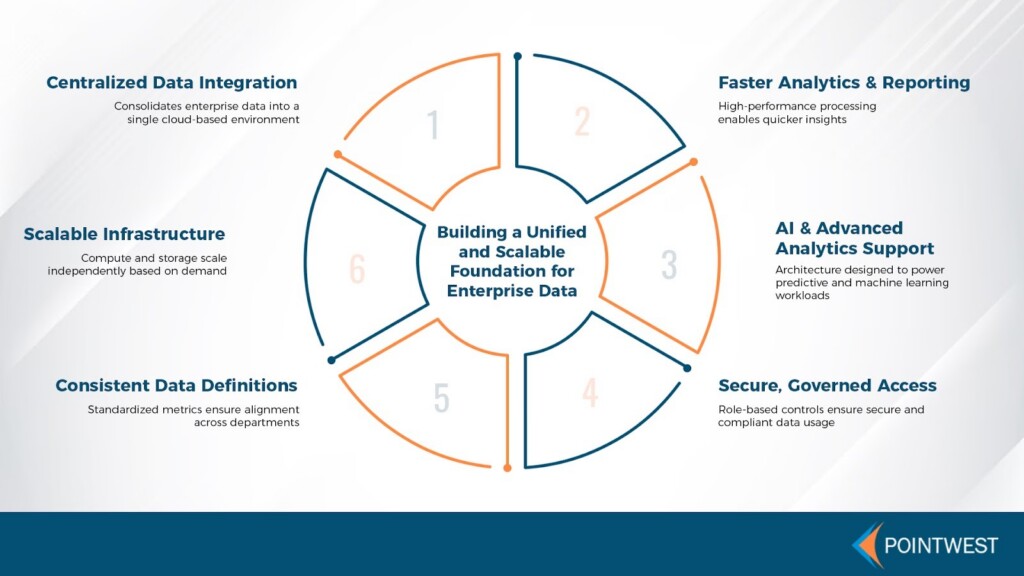
A cloud data platform consolidates different forms of enterprise data into a cohesive, scalable repository accessible to analytics, business intelligence (BI), and machine learning systems. Consolidation reduces fragmentation and minimizes the need for disparate reporting systems, shortening decision cycles and increasing confidence in analytics outputs. Organizations that adopt cloud-powered data platforms unlock a post-Moore’s Law approach to computing; separation of compute from storage and elastic scaling provide cost-effective options for maintaining performance under peak analytical load.
Contact us to know how Pointwest can support your journey toward agile, enterprise-ready systems
Governance and Operating Models That Support Scalable Adoption
A cloud data platform can centralize enterprise data at scale, but without strong governance it won’t deliver reliable, trusted insights across functions. Well-defined governance frameworks clarify data ownership, enforce quality standards, and ensure compliance, all of which are essential for operational adoption. Deloitte’s recent insights on establishing enterprise data governance bodies emphasize that despite strong prioritization of governance, most organizations struggle to mature these capabilities, with more than half reporting challenges in progressing beyond ad-hoc practices. Effective governance structures, which include formal councils and integrated stewardship, help ensure that data quality, access controls, and lifecycle management are consistently applied across the enterprise.
Modern governance is also evolving to support AI-ready and hybrid cloud ecosystems. Legacy governance models are insufficient in today’s dynamic environments and need to move from static compliance controls to frameworks that enable transparency, enforceable policy application, and metadata-driven automation. This integrated model reduces duplication of datasets, improves trust in analytics outcomes, and supports agile innovation across analytics, operational, and AI workloads.
The operating model plays an equally important role. Rather than centralizing all control, enterprise leaders increasingly adopt federated operating models that combine centralized standards with domain-oriented accountability. This hybrid model speeds up delivery of business-specific data products while maintaining enterprise-wide coherence and standards. Embedding governance into the daily processes and ensuring clear roles, from domain stakeholders to central governance leads, improves responsiveness and operationalizes governance rather than treating it as a disconnected compliance exercise.
This combined approach, governance integrated with clear operating models, prevents cloud data platform environments from reverting to fragmented systems and ensures that trusted, governed analytics can scale across functional lines without compromise.
Contact us to know how Pointwest can support your journey toward agile, enterprise-ready systems
Emerging Trends in Cloud Data Architecture
Unified cloud data platform architecture continues to evolve rapidly in response to enterprise demand for flexibility, AI support, and cross-platform interoperability. One major shift is the move toward hybrid and multi-cloud environments, where analytics and data analytics workloads span more than one provider to balance regulatory compliance, performance optimization, and resilience. For success in a multi-cloud data estate, governance and compliance considerations must be incorporated directly into architecture discussions, especially when managing data across clouds with differing standards and controls. In Financial Services and Healthcare, this approach supports data residency requirements and jurisdictional compliance. For Retail enterprises operating globally, it ensures resilience and reduced vendor concentration risk.
Integration of data and analytics with AI capabilities is another core architectural trend. AI is becoming deeply embedded into enterprise IT functions, reshaping traditional data architectures by enabling automated analytics, governance automation, and predictive insights. This means a unified cloud data platform must support not just historical reporting, but also machine learning workloads and real-time inference execution without excessive data movement or duplication.
Additionally, enterprises are increasingly adopting modern architectural patterns such as lakehouse and hybrid data mesh models to balance centralized governance with domain-specific agility. These architectures unify structured data warehouses with data lakes in a governed ecosystem, making both real-time analytics and AI workflows more efficient. While traditional warehouses were optimized for structured reporting only, this next generation supports multi-modal workloads under a single governance strategy.
Distributed and federated architecture models, where data ownership is shared across business domains but governed centrally, also gain traction as organizations scale analytics. Not only do these approaches reduce bottlenecks, they reinforce semantic consistency and prevent the formation of new data silos within cloud ecosystems. Emerging architecture strategies now emphasize interoperability contracts across data engines, ensuring that analytics, machine learning, and operational tasks can coexist without redundant pipelines.
Conclusion
A well-architected cloud data platform is more than infrastructure; it is a strategic asset that enables enterprises to unify data, scale analytics, and accelerate data-driven decisions. Architecture decisions, from compute/storage separation and automated pipelines to governance and hybrid operating models, directly influence whether an organization can leverage data as a competitive advantage.
Pointwest partners with enterprises to design and implement cloud data platforms that align with both business outcomes and operational realities. From strategic architecture and governance frameworks to integration pipelines and analytics enablement, Pointwest helps organizations build cloud data and analytics solutions that deliver measurable performance improvements and support future-ready data ecosystems.
About Pointwest
Pointwest is a global data-centric professional services firm that helps enterprises modernize their data foundations, integrate analytics across operations, and embed AI-driven intelligence into core business processes to drive measurable, sustainable growth. We deliver end-to-end solutions across software modernization, quality engineering and testing, data engineering, advanced analytics, AI/ML-driven solutions, and technology-driven business process outsourcing in revenue cycle management and pharmacy benefits administration. Leveraging business process engineering, cloud-native innovation, and industry best practices, we provide secure, reliable solutions that streamline operations and generate measurable business value.
With experience in Healthcare, Insurance, Banking, Financial Services and Retail, we help digital-first movers advance to enterprise-ready, and regulated production, drive large-scale technology transformations, and execute digital initiatives by optimizing business processes, enhancing customer experiences, and applying fit-for-purpose technology to enable business agility while managing operational risk and compliance.
Recognized for our global delivery model and technical expertise, we partner closely with enterprises to turn strategy into execution. Pointwest is a trusted digital partner of AWS, Google, UiPath, and Tricentis, and confirmed HIPAA Compliant.
To learn more, contact us.