
In 2026, most enterprises have a direction problem. Teams have automated plenty, yet release pipelines still slow down. Test runs take longer. Defects slip through. And the automation that was supposed to accelerate delivery starts doing the opposite.
Why? Because much of today’s automation is brittle and expensive to maintain. In 34% of organizations, ongoing maintenance and unresolved technical debt are the largest obstacles to delivering high-quality software. Every UI change triggers failures. Every release adds more noise. Test suites break faster than teams can fix them, and automation quietly turns into technical debt.
This is where a clear test automation strategy changes everything. It decides whether your testing setup evolves with your product or becomes yet another legacy system no one wants to touch. The real question enterprises need to answer in 2026 is “How do we build automation that survives constant change?”
That’s exactly what this blueprint is about. It lays out how to build a future-ready test automation strategy, one that ties directly to business outcomes, fits naturally into modern delivery pipelines, uses AI where it actually adds value, and makes quality stronger with every release instead of weaker.
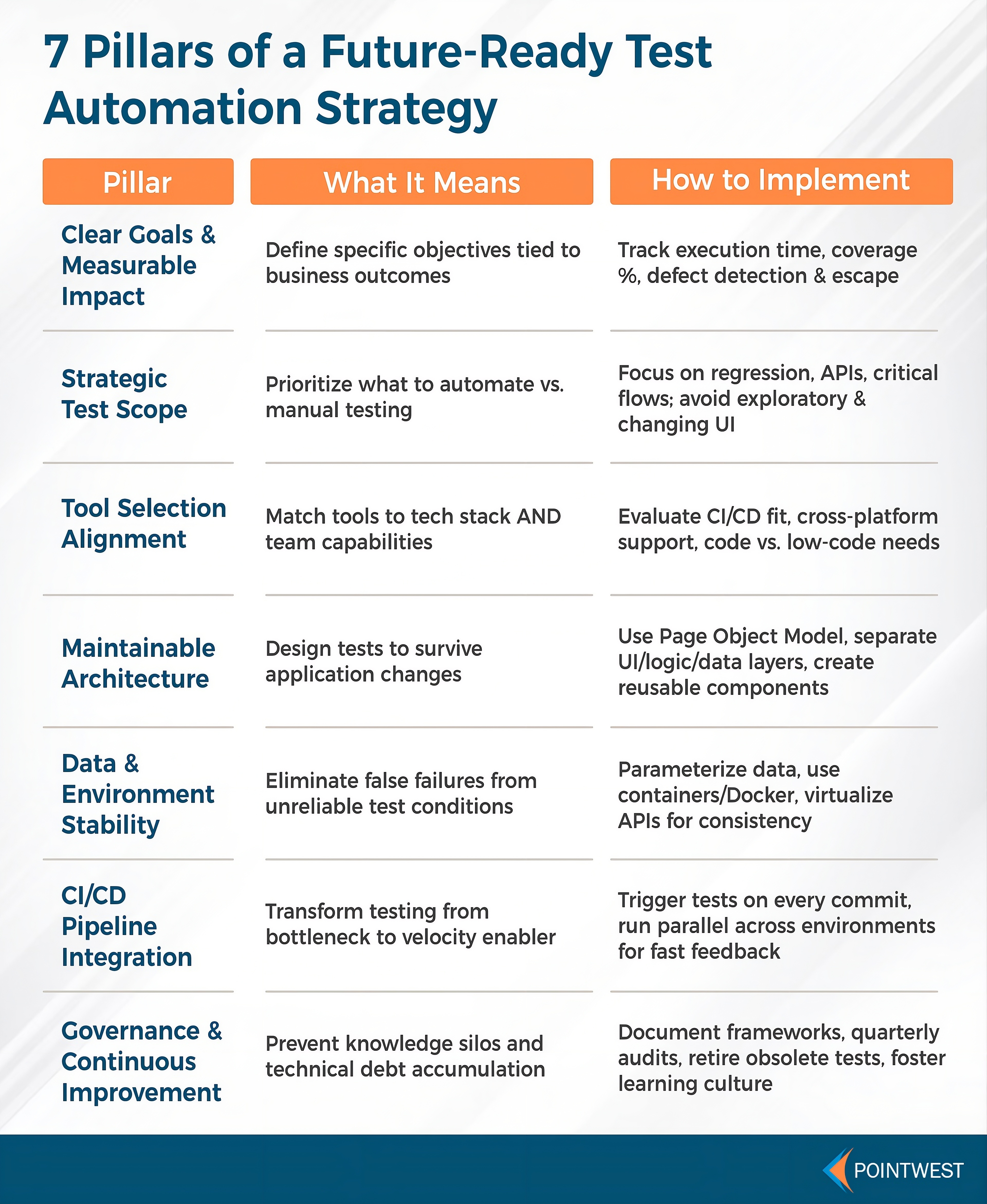
The Seven Pillars of a Future-Ready Test Automation Strategy
1. Defining Clear Goals with Measurable Impact
A successful test automation strategy begins with unambiguous objectives tied directly to business outcomes. Leading organizations anchor their strategies to specific KPIs: test execution time reduction, automation coverage percentage across critical user journeys, defect detection rates, and most critically, defect escape rates that measure what slips through to production. The automation testing market, now valued at $40.44 billion in 2026 and projected to reach $78.94 billion by 2031, reflects this shift from testing as cost to testing as competitive advantage.
2. Strategic Test Scope and Prioritization
Prioritize for automation through regression test suites that run with every release, high-frequency smoke tests, critical user flows that drive revenue, comprehensive API and integration tests, and performance validation under load.
Avoid automating exploratory tests requiring human intuition, frequently changing UI elements still in flux, low-value one-off scenarios, and usability assessments demanding human judgment. In the 2025 Tricentis Quality Transformation Report, 63% of organizations reported shipping code changes before completing all required testing, often driven by pressure to deliver faster, highlighting how strategic prioritization of automation and quality engineering separates high-performing teams from laggards.
3. Tool Selection Aligned with Tech Stack and Team Capabilities
Match frameworks to your technology landscape, web applications, mobile platforms, API layers, cloud infrastructure, and enterprise systems like SAP or Salesforce. Equally important: align with team capabilities. Do your engineers prefer code-based frameworks, or would low-code platforms democratize testing across product and business teams?
Evaluate CI/CD integration depth, cross-platform support, and community versus vendor backing. Market leaders like Tricentis dominate the space, recently securing top honors in two major industry reports. Tricentis was named a Leader in The Forrester Wave: Autonomous Testing Platforms (Q4 2025) and achieved the highest position for Ability to Execute in the inaugural Gartner® Magic Quadrant for AI-Augmented Software Testing Tools. Open-source alternatives include Selenium and Appium.
4. Engineering Principles: Maintainability as Architecture
Build for resilience from day one through modular, layered architecture. Separate UI interactions from business logic and test data. Implement proven design patterns: Page Object Model for UI stability, Repository Pattern for data management, Strategy Pattern for flexible test configurations.
The goal: reusable components that survive application changes. When a UI element shifts, you update one abstraction layer, not hundreds of brittle test scripts. Case examples from Tricentis customers show ~30% improvements in tester productivity and ~25% reductions in non-execution effort when structured test automation frameworks and shared repositories are adopted.
5. Data and Environment Management
Parameterize test data for flexibility across scenarios. Leverage data-as-a-service patterns and synthetic data generation for realistic, privacy-compliant test states. Stabilize test environments through virtualized APIs, containerization with Docker, and infrastructure-as-code that ensures consistency from local development through staging to production mirrors.
6. CI/CD Pipeline Integration for Continuous Feedback
Embedding automated tests into CI/CD pipelines transforms testing from a release bottleneck into a velocity enabler. Configure tests to trigger on every code commit or merge, enabling early defect detection when fixes cost least. Implement parallel execution across browsers, devices, and environments for rapid feedback. McKinsey found that about 60% of developers reported that CI/CD practices enabled them to nearly double deployment speed in software delivery, reflecting the importance of CI/CD for a digital-first organization.
7. Governance, Documentation, and Continuous Improvement
Establish clear ownership models, document frameworks and automation assets thoroughly, and conduct quarterly audits to retire obsolete tests while refining coverage based on production patterns.
Foster continuous learning through regular retrospectives, skill development programs, and knowledge sharing. The best test automation strategy is an evolving one, adapting to new technologies, changing application architectures, and lessons learned from production incidents.
Contact us to know how Pointwest can support your journey toward agile, enterprise-ready systems
Top Challenges in Enterprise Test Automation
Teams waste resources automating low-value, volatile, or exploratory scenarios better suited for manual execution when they lack rigorous prioritization based on execution frequency, stability, and business impact. Manual testing remains dominant, and addressing automation reliability and flakiness is critical to building trust at scale.
Choosing tools misaligned with your tech stack, team skills, or project needs creates dependency nightmares and maintenance overhead. Tests breaking across environments due to unreliable infrastructure or production data gaps that can’t be replicated further compound these challenges. Without proper architecture, even minor code changes trigger cascading test failures.
Perhaps most insidiously, knowledge silos form around automation experts, creating bottlenecks when those individuals leave. Technical debt accumulates invisibly until migration or scaling becomes prohibitively expensive, forcing organizations to confront years of shortcuts taken in the name of speed.
Role of AI in Modern Test Automation Strategy
AI has rapidly become a foundational pillar of the modern test automation strategy. A Tricentis survey found that nearly 70% of respondents rate AI-augmented testing as extremely or very valuable, and 65% of respondents identified functional testing as the area best suited for AI-driven approaches. AI-driven automation now goes far beyond speed gains.
Intelligent systems can automatically convert user stories, requirements, and code changes into executable test cases, using natural language processing to let teams describe scenarios in plain English—effectively democratizing automation beyond engineering-heavy QA teams. At the execution layer, self-healing capabilities address one of enterprise automation’s biggest pain points by detecting UI changes, updating locators, and repairing broken scripts with high success rates, dramatically reducing maintenance overhead.
AI also introduces predictive intelligence into test planning by analyzing code churn, historical defect data, and user behavior to identify high-risk areas, enabling teams to shift from reactive “test everything” approaches to targeted, risk-based automation. It continuously monitors test execution to detect flaky tests and perform automated root cause analysis, distinguishing between code defects, environment instability, and poor test design. Complementing this, AI-powered visual validation enables large-scale visual regression testing across browsers and devices, catching subtle UI anomalies that traditional assertions and manual reviews often miss.
Building Your 2026 Test Automation Blueprint
Start with business-aligned goals. Automate strategically based on value. Select tools matching your ecosystem. Architect for maintainability. Integrate deeply into CI/CD pipelines. Leverage AI to handle the scale and speed that human teams can’t match.
But strategy alone delivers nothing. Execution separates winners from aspirants. That’s where engineering-led quality assurance makes the difference, not just finding bugs, but building systems that prevent them, designing test automation that survives organizational change, and embedding quality so deeply into delivery that it becomes invisible yet omnipresent.
Pointwest’s Quality Engineering and Testing practice brings an engineering-first mindset to test automation strategy. We don’t just automate your tests, we re-engineer your release cycles, delivering demonstrated results like shrinking critical path testing from three-week manual processes to sub-one-hour automated execution. Our teams build test automation the same way modern software is built: modular, versioned, reviewable, and designed to scale rather than stagnate.
Let’s build your 2026 test automation blueprint together. Reach out to learn more.
About Pointwest
Pointwest is a global professional services firm enabling enterprises to transform systems into agile, interconnected business services that integrate operations, enhance digital customer experiences, and drive sustainable growth. We deliver end-to-end solutions across software modernization, quality engineering and testing, data engineering, advanced analytics, and AI/ML-driven solutions, leveraging cloud-native innovation, engineering discipline, and best practices to provide solutions that are secure, reliable, and generate measurable business value.
With experience in Banking, Financial Services, Insurance, Healthcare, and Retail, we help digital-first movers advance to enterprise-ready, and regulated production, drive large-scale technology transformations, and execute digital initiatives by optimizing business processes, enhancing customer experiences, and applying fit-for-purpose technology to enable business agility while managing operational risk and compliance.
Recognized for our global delivery model and technical expertise, we partner closely with enterprises to turn strategy into execution. Pointwest is a trusted digital partner of AWS, Google, UiPath, and Tricentis.
To learn more, contact us.


